
Many college students struggle with chemistry calculations, especially when titration appears in homework and exams. One of the most common questions students type into Google is how to solve chemistry titration problems easily. Because titration problems mix chemical reactions, formulas, and math, they often feel confusing at first.
However, titration is not as hard as it looks. Once you understand the pattern, the questions become much easier. In this complete guide, you will learn how to solve chemistry titration problems easily by using simple steps, clear formulas, and detailed college-level examples. As a result, U.S. college students can approach chemistry with more confidence and much less stress.
✅ What Are Chemistry Titration Problems?
Chemistry titration problems are questions that help you find an unknown value by reacting it with a solution of known concentration. In most college labs and exams, titration is used to calculate molarity, volume, or moles of an acid or a base.
In general, titration problems help students:
- Measure unknown concentrations
- Practice stoichiometry
- Understand acid–base reactions
- Connect lab work with calculations
- Prepare for chemistry exams
Usually, a titration problem includes an acid, a base, a balanced equation, and one or more known values. From there, you must calculate what is missing.
✅ Why Do College Students Find Chemistry Titration Problems Difficult?
Many U.S. college students feel nervous when titration appears in a test. For example, some students forget where to start. Others feel lost when they see long questions with numbers and formulas.
In addition, confusion between moles, molarity, and volume often creates mistakes. Because of that, even students who understand chemistry theory may still lose marks. Moreover, rushing through steps increases errors.
However, titration problems follow a predictable system. Once you learn that system, everything becomes clearer. In fact, almost every titration question uses the same basic logic.
✅ Core Concept to Solve Chemistry Titration Problems Easily
Before solving any titration problem, one rule must stay in your mind:
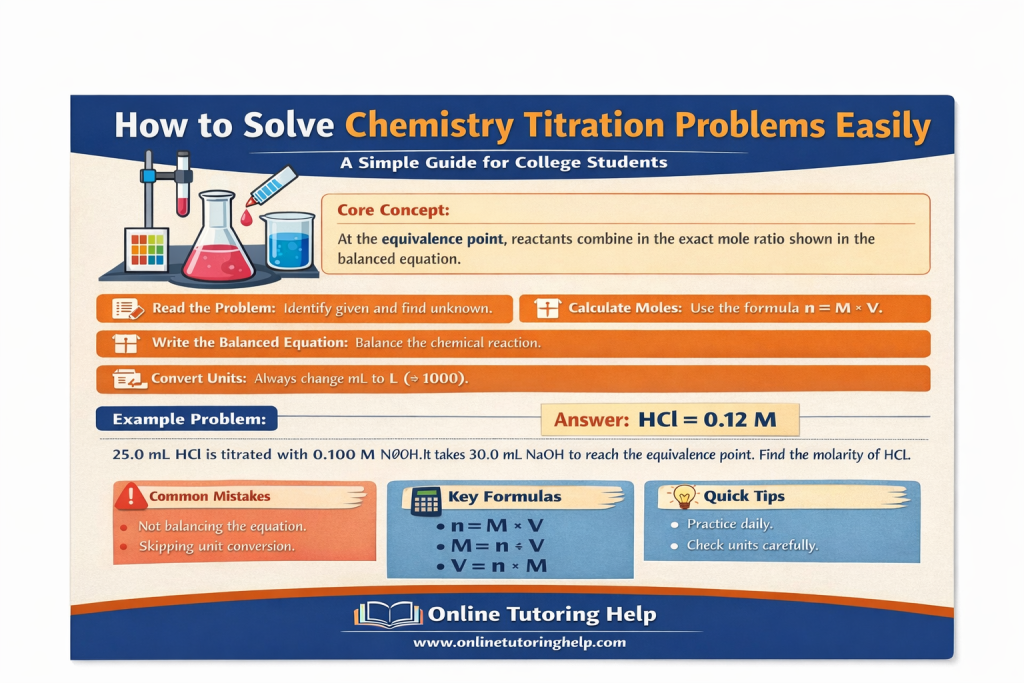
At the equivalence point, reactants combine in the exact mole ratio shown in the balanced equation.
Because of this, balancing the equation always comes first.
The most important formula is:
Moles = Molarity × Volume
n = M × V
Where:
M = molarity (mol/L)
V = volume (L)
n = number of moles
This simple formula connects almost every step in titration calculations.
✅ Step-by-Step Method to Solve Chemistry Titration Problems Easily
A clear system reduces stress and mistakes. Therefore, always follow the same order.
🔹 Step 1 – Read the Chemistry Titration Problem Carefully
First, read the full problem slowly. Then, underline the known values. After that, circle what you must find. By organizing information early, you prevent careless errors later.
🔹 Step 2 – Write the Balanced Equation for Titration Problems
Next, write the chemical reaction. After writing it, balance the equation. This step matters because the coefficients control the mole ratio. Without a balanced equation, correct calculations are impossible.
🔹 Step 3 – Convert Units in Chemistry Titration Calculations
Most chemistry problems give volume in milliliters. Therefore, always convert milliliters into liters.
Liters = mL ÷ 1000
Otherwise, even correct formulas will give wrong answers.
🔹 Step 4 – Calculate Moles in Titration Problems
Now apply the main formula:
n = M × V
At this stage, you calculate the moles of the known solution. Once this value is ready, move to the reaction ratio.
🔹 Step 5 – Use Mole Ratios in Chemistry Titration Problems
Look closely at the balanced equation. If the ratio is 1:1, the moles stay the same. On the other hand, if the ratio is different, multiply or divide. In this way, you correctly match chemical relationships.
🔹 Step 6 – Final Formula to Solve Chemistry Titration Problems Easily
Finally, use the correct formula to find the unknown:
M = n ÷ V
V = n ÷ M
n = M × V
At the end, check units, review rounding, and confirm the answer makes sense.
✅ Easy Example to Solve Chemistry Titration Problems
Problem:
25.0 mL of hydrochloric acid is titrated with 0.100 M sodium hydroxide. It takes 30.0 mL of NaOH to reach equivalence. Find the molarity of HCl.
Balanced equation:
HCl + NaOH → NaCl + H₂O
Step 1 – Convert volume:
30.0 mL = 0.030 L
Step 2 – Calculate moles:
0.100 × 0.030 = 0.003 mol NaOH
Step 3 – Apply ratio:
The ratio is 1:1, so HCl moles = 0.003 mol
Step 4 – Convert acid volume:
25.0 mL = 0.025 L
Step 5 – Find molarity:
0.003 ÷ 0.025 = 0.12 M
✔ Answer: HCl = 0.12 M
✅ Advanced Example of Chemistry Titration Calculations
Problem:
20.0 mL of sulfuric acid reacts with 0.150 M sodium hydroxide. If 40.0 mL of NaOH is required, find the molarity of sulfuric acid.
Balanced equation:
H₂SO₄ + 2NaOH → Na₂SO₄ + 2H₂O
Convert volume:
40.0 mL = 0.040 L
Calculate moles:
0.150 × 0.040 = 0.006 mol NaOH
Apply ratio:
2:1, so H₂SO₄ = 0.006 ÷ 2 = 0.003 mol
Convert acid volume:
20.0 mL = 0.020 L
Find molarity:
0.003 ÷ 0.020 = 0.15 M
✔ Answer: 0.15 M
✅ Common Mistakes in Chemistry Titration Problems
One common mistake is skipping the balanced equation. Another frequent issue involves forgetting unit conversions. As a result, many students lose easy marks.
In addition, rushing through steps often creates confusion. Instead, students should slow down and organize data first. When values appear clearly on paper, accuracy improves quickly.
✅ Important Formulas to Solve Chemistry Titration Problems Easily
| Purpose | Formula |
|---|---|
| Find moles | n = M × V |
| Find molarity | M = n ÷ V |
| Find volume | V = n ÷ M |
| Unit conversion | mL ÷ 1000 = L |
✅ Types of Chemistry Titration Problems in College
🔬 Acid–Base Titration
Most general chemistry courses focus on this type.
⚡ Redox Titration
These problems involve electron transfer reactions.
🧲 Complexometric Titration
Often used with EDTA in analytical chemistry.
🔄 Back Titration
Used when direct titration becomes difficult.
✅ How Titration Appears in College Courses
Titration is not limited to one chapter. Instead, it appears across multiple chemistry subjects. For instance, general chemistry introduces acid–base titrations. Later, analytical chemistry expands into redox and complexometric titrations. In lab courses, titration helps determine unknown concentrations.
Because titration spreads across courses, mastering it early saves time and stress.
✅ Simple Tips to Solve Chemistry Titration Problems Faster
- Practice a few problems every day
- Keep a formula sheet for revision
- Review lab experiments carefully
- Check units at every step
- Ask for help when confusion starts
- Rework mistakes to learn faster
Over time, these habits build strong chemistry confidence.
✅ Why Students Need Help With Chemistry Titration Problems
College chemistry moves quickly. Therefore, many students feel overwhelmed by lectures, labs, and assignments happening together. When foundations remain weak, titration becomes stressful.
Because titration appears frequently in exams and lab reports, many U.S. college students search for chemistry help. With the right guidance, however, titration becomes manageable and even enjoyable.
✅ Final Thoughts on Solving Chemistry Titration Problems Easily
Learning how to solve chemistry titration problems easily does not require memorization. Instead, it requires understanding one clear system. Once that system becomes familiar, each new problem feels predictable.
Over time, confidence increases. As a result, students perform better in labs, homework, and exams. Ultimately, mastering titration makes chemistry far less stressful and much more manageable.
For more details visit – www.onlinetutoringhelp.com
Whatsapp no. – +918962306086