
Introduction
Foundation design is one of the most important topics in geotechnical engineering. Many students look for Foundation Design Assignment Help to understand how to apply soil mechanics and structural concepts to real projects.
Foundation design is one of the core topics in geotechnical engineering. Every structure—whether it’s a house, bridge, or skyscraper—relies on a properly designed foundation to safely transfer loads to the ground. The foundation is what ensures stability, durability, and safety of structures under various conditions.
For students studying civil or geotechnical engineering, foundation design assignments can be challenging because they combine soil mechanics, bearing capacity, structural design, and construction techniques. If you’ve ever felt lost while solving a foundation-related problem or confused about how to distinguish between shallow and deep foundations, you’re not alone.
In this detailed guide, we’ll explain everything you need to know about foundation design, explore the differences between shallow and deep foundations, and show how online tutoring and assignment help can support your academic success.
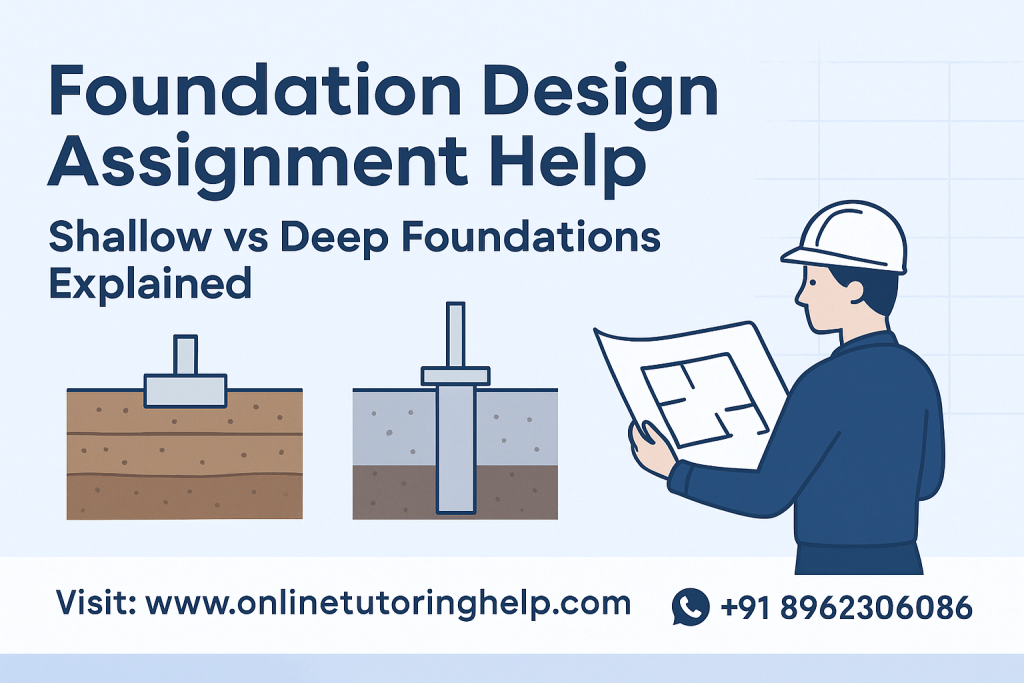
What Is Foundation Design in Geotechnical Engineering? – Foundation Design Assignment Help Overview
Foundation design is the process of determining the size, depth, and type of foundation required to safely support a structure. In geotechnical engineering, the design is based on soil characteristics, load distribution, and the type of structure.
The foundation’s role is to transfer the loads from the structure (dead loads, live loads, wind, seismic) to the soil without causing settlement or failure.
A well-designed foundation prevents structural damage and ensures long-term stability.
Key Goals of Foundation Design
- Safety: Prevent structural collapse or excessive settlement.
- Serviceability: Maintain comfort and usability without cracks or tilts.
- Economy: Achieve stability with minimum material and construction cost.
- Durability: Withstand environmental and chemical conditions of soil.
In your foundation design assignments, you’ll often need to calculate bearing capacities, estimate settlements, and choose the right type of foundation based on soil data.
Classification of Foundations
Foundations are primarily classified into two categories:
- Shallow Foundations
- Deep Foundations
The distinction is based on the depth of the foundation relative to its width and the type of soil that supports the structure.
| Criteria | Shallow Foundation | Deep Foundation |
|---|---|---|
| Depth | Depth ≤ width | Depth >> width |
| Load Transfer | Near the surface | To deeper, stronger strata |
| Examples | Spread footing, mat foundation | Piles, caissons, drilled shafts |
| Cost | Low to moderate | High |
| Construction | Simple, quick | Complex, requires equipment |
| Common Use | Light to medium structures | High-rise, bridges, heavy loads |
Shallow Foundations – Overview and Types
Definition
A shallow foundation is one that transfers building loads to the earth at a depth not greater than its width. These are typically used where the surface soils can safely bear the structural loads.
Types of Shallow Foundations
- Isolated Footing (Pad Footing):
Used to support individual columns. Each footing is designed independently.
Example: Small buildings with regular column spacing. - Combined Footing:
Supports two or more columns when they are close together.
Example: Industrial sheds or structures near boundaries. - Strap (Cantilever) Footing:
Two isolated footings are connected by a strap beam. Used when columns are close to property lines. - Raft (Mat) Foundation:
A large concrete slab under the entire building, distributing loads evenly.
Example: High-rise buildings with weak surface soils.
Advantages of Shallow Foundations
- Simple construction process.
- Cost-effective for low-rise buildings.
- Easy to inspect and maintain.
- Suitable for most residential and light commercial structures.
Limitations
- Not suitable for weak or compressible soils.
- Can experience differential settlement.
- Limited depth capacity (up to about 3 meters).
Deep Foundations – Overview and Types
Definition
A deep foundation transfers loads to deeper soil layers or rock strata, bypassing weak or compressible upper layers. These are essential when near-surface soils cannot provide adequate bearing capacity.
Types of Deep Foundations
- Pile Foundations:
Long, slender columns driven or drilled into the ground to reach stronger soil or rock.- Driven Piles: Precast concrete or steel piles hammered into the ground.
- Bored Piles: Cast-in-place piles drilled with augers.
- Caissons (Drilled Shafts):
Large-diameter shafts drilled to reach strong strata, then filled with reinforced concrete. Common in bridge piers and heavy towers. - Pier Foundations:
Cylindrical columns supporting structures above the ground level. Used where deep excavation is impractical. - Well Foundations:
Traditional deep foundations used for bridges and water structures.
Advantages of Deep Foundations
- Ideal for heavy loads and poor surface soils.
- Reduces settlement risk.
- Suitable for tall buildings, towers, and bridges.
Limitations
- Expensive and time-consuming.
- Requires specialized equipment.
- Difficult to inspect after construction.
Shallow vs Deep Foundations – Detailed Comparison
| Parameter | Shallow Foundation | Deep Foundation |
|---|---|---|
| Depth | Up to 3 m | More than 3 m |
| Load Transfer Mechanism | Directly to near-surface soil | To deeper, stronger strata |
| Bearing Capacity Requirement | High near-surface bearing capacity | Low near-surface bearing capacity |
| Soil Type | Hard or dense soil near surface | Weak or compressible top soil |
| Construction Time | Fast | Slow |
| Cost | Economical | Expensive |
| Equipment Required | Basic tools and manpower | Heavy machinery |
| Examples | Footings, rafts | Piles, caissons |
| Suitability | Residential & low-rise | High-rise & heavy structures |
Key Design Parameters in Foundation Design Assignments
In your geotechnical foundation design assignments, you will often need to calculate the following:
- Bearing Capacity of Soil:
The maximum load per unit area that the soil can support without failure.
Formula (Terzaghi’s Bearing Capacity):
[
q_u = cN_c + \gamma D_f N_q + 0.5 \gamma B N_\gamma
]
where:
c = cohesion, γ = unit weight of soil, D_f = depth of foundation, B = width, N_c, N_q, N_γ = bearing capacity factors. - Settlement Analysis:
Determines how much the structure will sink under load. Excessive settlement can cause cracks and instability. - Safety Factor:
Foundations are designed with a safety factor (typically 2.5–3) to prevent failure. - Load Combinations:
Includes dead load, live load, wind, and seismic loads as per IS/ACI codes.
Common Mistakes Students Make – Foundation Design Assignment Help Tips
- Ignoring Soil Data:
Using assumed soil parameters instead of actual data leads to inaccurate design. - Mixing Up Shallow and Deep Foundations:
Choosing the wrong foundation type can cause structural failure. - Neglecting Settlement Calculations:
Even strong foundations can fail if settlement is uneven. - Incorrect Unit Conversions:
Errors in units (kN/m², psi, etc.) often lead to wrong answers. - Not Considering Construction Feasibility:
Theoretical design may be perfect, but practically impossible to build.
How Online Tutoring Provides Foundation Design Assignment Help for Geotechnical Students
1. Personalized Learning
Online tutoring provides one-on-one guidance from experienced geotechnical engineers. You can clarify your doubts about soil mechanics, bearing capacity, or structural loads at your own pace.
2. Step-by-Step Assignment Help
Expert tutors help you break down complex problems into manageable steps — ideal when solving long calculation-based assignments.
3. Concept Reinforcement
Visual explanations, simulations, and diagrams make it easier to understand the load transfer mechanisms in foundations.
4. Time Management
Tutors help you complete your foundation design assignments before deadlines and prepare for exams with structured study plans.
5. Real-World Applications
Many tutors bring industry experience, explaining how theoretical foundation design applies to actual projects like bridges, dams, and skyscrapers.
Practical Examples: Choosing Between Shallow and Deep Foundations
Example 1 – Residential Building
A two-story house on firm clay soil.
→ Use shallow foundation (isolated footing).
Example 2 – Multi-Story Office Building
A 15-story structure on soft clay.
→ Use deep foundation (piles) to transfer loads to deeper, stronger layers.
Example 3 – Bridge Pier in River
Bridge foundations exposed to water and scouring.
→ Use well or caisson foundation for stability.
These examples often appear in geotechnical design homework to test your understanding of soil-structure interaction.
Foundation Design Codes and Standards
Depending on your university or country, foundation design assignments may refer to:
- IS 6403 (India): Bearing Capacity of Shallow Foundations
- ACI 336 (USA): Foundation Design Requirements
- Eurocode 7 (Europe): Geotechnical Design Principles
- BS 8004 (UK): Foundations Code of Practice
Understanding these standards will help you interpret questions correctly and achieve full marks in your assignments.
Tips to Score High in Foundation Design Assignments
- Start with a clear understanding of soil investigation reports.
- Use correct units and conversion factors.
- Show detailed calculations step-by-step.
- Justify your choice of foundation type.
- Include clear sketches of foundation layout.
- Reference relevant standards (IS, ACI, Eurocode).
- Use software tools like PLAXIS, STAAD Foundation, or SAFE if allowed.
Common University Assignments on Foundation Design
- Compare bearing capacities for different soil types.
- Design an isolated footing for a column.
- Calculate settlement for a raft foundation.
- Choose between pile and mat foundation for given site data.
- Write a report on site investigation and foundation recommendations.
If you get stuck on any of these, online tutoring can help you approach the problem logically and ensure you understand the theory behind every step.
Why Choose OnlineTutoringHelp.com for Geotechnical Engineering Assignments
At www.onlinetutoringhelp.com, we provide expert tutoring and assignment help for civil and geotechnical engineering students across the USA. Our tutors specialize in foundation design, soil mechanics, structural analysis, and other core engineering topics.
Our Key Features
- 24/7 one-on-one tutoring sessions
- Step-by-step assignment guidance
- Assistance with software tools like PLAXIS, GeoStudio, and SAFE
- Affordable rates for students
- 100% plagiarism-free solutions
- On-time delivery and live chat support
Whether you need foundation design assignment help, live tutoring sessions, or last-minute homework support, our experts are ready to assist you.
If you need Foundation Design Assignment Help or one-on-one guidance in geotechnical topics, connect with our expert tutors.”
Conclusion
Foundation design is a crucial part of geotechnical engineering that every civil engineer must master. Understanding the difference between shallow and deep foundations is essential for creating safe and economical structures.
By learning the key design parameters, avoiding common mistakes, and getting personalized guidance from online tutors, you can confidently complete your foundation design assignments and perform better in exams.
If you ever find foundation design challenging, remember — expert tutors at OnlineTutoringHelp.com are here to make learning easier, faster, and more practical.