
Part 1: The Context & Introduction
Is your dinner table conversation constantly interrupted by crying, arguing, or the sheer weight of frustration? Does the word “homework” trigger a nightly skirmish in your home? If you’ve reached the point where you suspect your child needs homework intervention, you are not alone. The nightly homework struggle is one of the biggest sources of stress for modern families, and a pattern of extreme difficulty or emotional conflict is a clear signal that something in the system is broken. This isn’t just about lazy habits; it’s often a symptom of underlying academic or organizational gaps that require a proactive strategy.
The Goal of Homework: Setting the Standard
Homework, at its best, serves three main purposes: to reinforce classroom lessons, to teach responsibility and independent work habits, and to develop time management skills. When homework reliably achieves none of these goals and instead causes stress and tears, it has crossed the line from educational tool to emotional roadblock. (For more on the academic benefits, see this resource from the U.S. Department of Education).
Defining “Intervention”
The term “homework intervention” might sound serious, but it simply means implementing a proactive, strategic shift in your approach. An intervention is a supportive act—a chance to stop a negative cycle and replace it with structure, skill-building, and professional help when needed. The goal is to move from daily conflict to independent learning.
The key to fixing the problem is identifying it early. Waiting too long allows small skill deficits to turn into large academic gaps and significant emotional trauma. Understanding the signs your child needs a homework intervention is the biggest step you can take toward restoring peace and success.
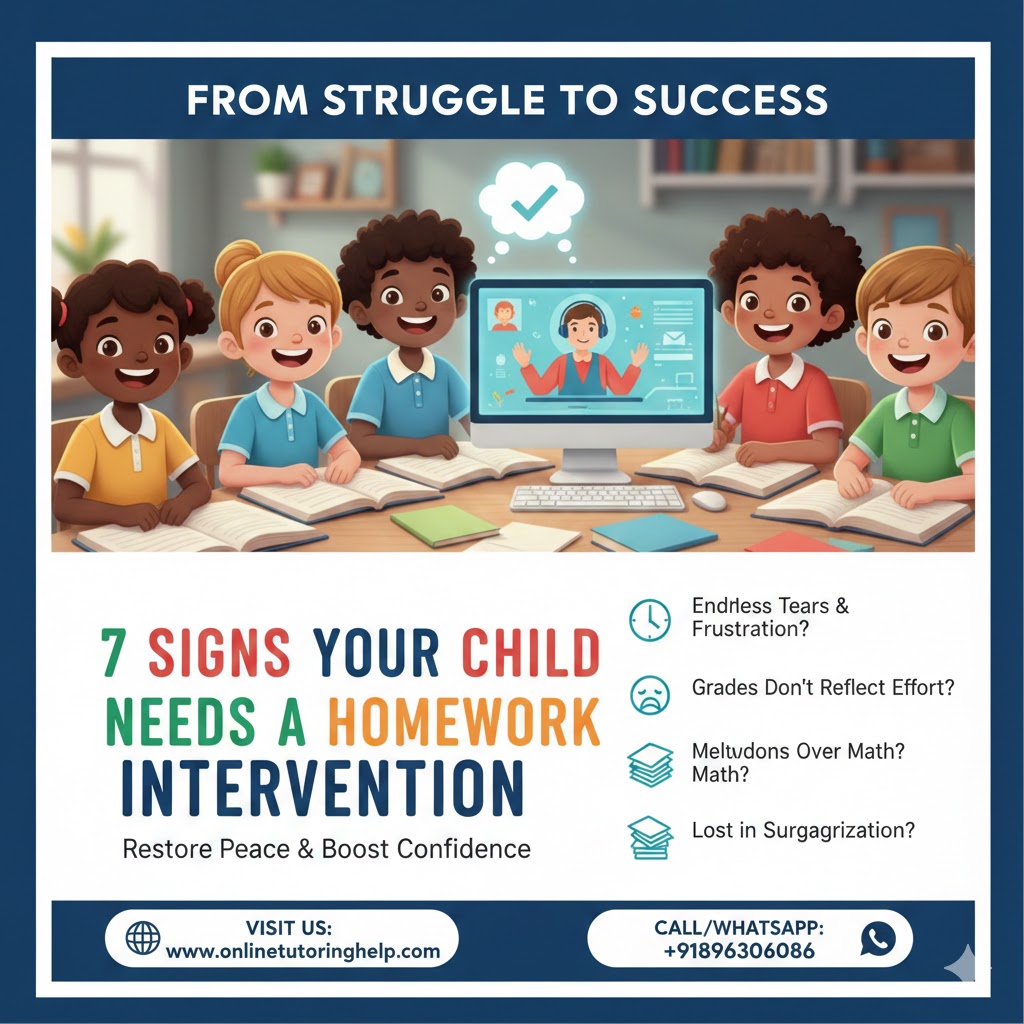
Part 2: Identifying When Your Child Needs Homework Intervention
These seven signs, when seen consistently, indicate a genuine need to re-evaluate your child’s approach to learning and assignments.
Sign 1: Academic Struggle – Homework Consistently Taking Too Long
The Observation: A teacher assigns a reading and corresponding worksheet expected to take 45 minutes, but your child struggles with it for two hours (or more) every night.
The Deeper Meaning: The Efficiency Deficit
When homework drags on, it’s rarely just simple procrastination. The problem is usually rooted in one of three areas:
- Learning Gap: They may be missing a foundational skill necessary for the current task. They spend time cycling through solutions they don’t understand, resulting in wasted effort.
- Focus/Attention: They lack the executive function skills to stay on task, constantly switching attention, seeking distractions, or needing constant redirection.
- Inefficient Methods: They don’t know how to study or approach the material efficiently (e.g., they read the entire chapter before looking at the questions).
Actionable Next Steps:
- Implement a Time-Limit Rule: Work with your child to set realistic goals. “We will work on math for 40 minutes, and then we take a break.” If the time runs out, contact the teacher to discuss the volume of work and the struggle.
- Use the Pomodoro Technique: Use a timer for short, focused bursts (e.g., 25 minutes of work, 5 minutes of break). This teaches discipline and makes the task feel less daunting.
Sign 2: Emotional Outbursts and Avoidance
The Observation: Tears, slamming books, sudden anger, or developing a “stomachache” or “headache” that only appears five minutes before homework starts.
The Deeper Meaning: The Anxiety Overload
When a child has a meltdown over a worksheet, they are likely not upset about the paper itself—they are struggling with the overwhelming feeling of being unable to complete the task successfully. This is a profound indicator of anxiety and a fear of failure. Homework has become associated with stress, shame, and defeat. Their brain has learned to associate the assignment with negative emotions, triggering a flight-or-fight response. (If emotional outbursts are severe or frequent, you may find helpful resources on child anxiety and behavior from the American Academy of Pediatrics).
This emotional trauma is one of the clearest signs your child needs a homework intervention that addresses mental well-being alongside academics.
Actionable Next Steps:
- Validate, Don’t Dismiss: Instead of saying, “It’s not that hard, just do it,” try: “I see you’re feeling really frustrated right now. Let’s take a five-minute break and breathe. We can come back to this tough problem together.”
- Separate the Parent from the Instructor: Your relationship should be built on support, not conflict. If you are the source of the conflict, an objective third party (like a tutor) is essential.
Sign 3: Low Grades Despite Effort (The “Missing Brick”)
The Observation: You know your child is smart, and you see them putting in the time and effort, but the finished product (the test score or assignment grade) is consistently low.
The Deeper Meaning: The “Missing Brick” Foundation
This is perhaps the most frustrating sign for parents. This issue almost always points to a foundational knowledge gap. Think of learning like building a brick wall: if a crucial “brick” (like knowing how to multiply fractions or the basic rules of capitalization) is missing from the foundation, everything built on top of it will be shaky. The child might be trying hard, but they lack the essential prerequisite skill to succeed at the current task.
Without professional help, this gap only widens as the curriculum moves forward.
Actionable Next Steps:
- Talk to the Teacher about Specifics: Ask the teacher, “What is the specific prerequisite skill they are missing?” (e.g., “They struggle with regrouping,” or “They don’t understand the difference between primary and secondary sources.”)
- Targeted Remediation: Once the gap is identified, seek focused help. This is the sweet spot for professional tutoring, which can quickly identify and fill those holes before moving on.
Sign 4: Lack of Independence and Reliance on Homework Help
The Observation: Your child requires your direct, constant presence to complete even simple tasks. If you leave the room, they stop working, and they constantly ask for help on every single problem.
The Deeper Meaning: The Dependence Trap
When the parent becomes the co-pilot for every assignment, the child fails to develop two key things: confidence and self-monitoring. They are dependent on external cues (your approval or direction) to proceed. They are not learning to check their own work or troubleshoot problems because they rely on you to catch errors or tell them the next step.
This creates an unsustainable routine that hinders the transition to middle school and high school, where independence is mandatory.
Actionable Next Steps:
- The “Three Before Me” Rule: Tell your child they must try at least three things (read the text again, look at their notes, try two different approaches) before they can ask you for homework help. This forces them to engage in the problem-solving process.
- Establish “Quiet Work Time”: Sit nearby and work on your own tasks (reading, paying bills), but do not engage with their homework unless they have completed a defined chunk of work.
Sign 5: Chronic Disorganization and Executive Function Gaps
The Observation: The backpack is a black hole, papers are perpetually crumpled, and assignments that you know were completed are rarely submitted because they are lost or forgotten.
The Deeper Meaning: Executive Function Deficits
Many people mistake chronic disorganization for laziness, but it’s often a sign of underdeveloped executive function skills—the mental processes that help us plan, organize, prioritize, and manage time. A child might know the math but lose the worksheet or forget to write the due date down. They cannot sequence the steps needed to complete a project (e.g., get materials, break into steps, allocate time, check criteria, submit). (You can learn more about Executive Function and its impact on school performance).
This is a critical sign your child needs a homework intervention focused on skill-building, not just academics.
Actionable Next Steps:
- Color-Coding System: Use a consistent color for each subject (e.g., Red for Math, Blue for English) and stick to it for folders, notebooks, and textbook covers.
- Daily Clean-Out Routine: Establish a 5-minute ritual at the end of the day or right after school to empty the backpack and place everything into the appropriate “in-box” for homework or the “to-be-filed” pile.
Sign 6: The “I Don’t Care” Attitude Emerges
The Observation: Your child responds to failing grades or major assignment warnings with shrugs, apathy, and phrases like “Whatever, I don’t care.”
The Deeper Meaning: The Defense Mechanism
When a child has consistently failed despite trying hard, the feeling of incompetence becomes too painful to face. Saying “I don’t care” is a protective defense mechanism. It is far easier for a child to live with the perception that they are “lazy” than to admit and feel that they are “incapable.”
This attitude requires an emotional intervention that addresses the underlying fear of failure before any academic progress can be made.
Actionable Next Steps:
- Shift the Focus to Effort: Stop emphasizing the grade. Instead, focus on the process: “I am proud of you for working consistently for an hour tonight.” or “I like how you went back to look up that definition.”
- Find the “Why”: Help the child connect their learning to a future passion or interest. If they love gaming, relate math to coding or probability.
Sign 7: The Parent is Doing the Homework
The Observation: This is the ultimate red flag. You find yourself writing the introduction to an essay, solving complex algebraic equations, or staying up late to finish a project just to “get it done” or avoid a confrontation.
The Deeper Meaning: The Broken System
This is the most serious sign that the current homework system in your house is completely broken and that the child needs a homework intervention immediately. While it offers short-term relief, it teaches the child nothing, creates a false sense of academic security, and severely damages the parent-child relationship by making the parent the enforcer/doer instead of the supporter.
Actionable Next Steps:
- Establish a “No-Rescue” Policy: Define clear boundaries. Your role is to ask clarifying questions (“What are the instructions asking you to do?”) but never to provide the answer or do the work.
- Prioritize Learning Over Grades: It is better for your child to submit an incomplete or incorrect assignment (and learn the consequences) than to submit a perfect one that you completed. Learning from mistakes is vital.
Part 3: Tailoring the Intervention: How to Get Homework Support
Recognizing these signs is only the first part of the intervention. The next steps involve strategic action to move from acknowledgment to resolution.
Step 1: The Parent-Child Conversation
Approach your child calmly, focusing on empathy and teamwork.
“I have noticed that homework has become a huge source of stress for both of us, and I don’t want that for you. It looks like you’re trying really hard, but it’s just not working right now. We are going to work together to find a better system and get you the support you need.”
Focus on solutions, not past failures or blame.
Step 2: Seeking School Support
Schedule a brief meeting with your child’s teacher. Share your observations (Signs 1, 2, 4, and 5 are most relevant). Ask for the teacher’s perspective and request resources. For deeper, pervasive issues, ask the school counselor or psychologist for an assessment to rule out learning disabilities or significant anxiety.
Step 3: Self-Assessment (Internal Solutions)
Before seeking external help, try refining the home environment:
- The Schedule: Implement a non-negotiable, consistent start time for homework, even if it’s just 15 minutes of quiet time.
- The Space: Ensure the study area is distraction-free, quiet, and well-lit.
- Screen Time: Homework time should be screen-free (unless the assignment requires it). Limit digital access before the work is done.
Step 4: When Professional Support is Required
If the foundational gaps (Sign 3) or executive function issues (Sign 5) are persistent, an external, unbiased expert is often the most efficient and peace-restoring solution.
Why an External Expert is Often Necessary:
A professional tutor brings three essential elements:
- Objectivity: They are a neutral party, removing the emotional friction that often defines the parent-child homework dynamic.
- Diagnosis: A skilled tutor can quickly diagnose the “missing brick” (the specific foundational skill gap) that is causing the current assignments to feel impossible.
- Skill Transfer: They don’t just teach the material; they teach the child how to learn—organizational skills, effective note-taking, and study strategies that lead to true independence.
Here at Online Tutoring Help (https://www.onlinetutoringhelp.com), our tailored intervention plans focus on addressing the root causes of these struggles, creating a supportive, personalized plan that restores confidence and academic momentum. We turn frustration into focused progress.
Part 4: Conclusion
Don’t let the homework battle continue another night. Recognizing the signs is the first step—taking action is the next. End the stress and get your child the personalized support they need today.
Ready for a Solution?
🌐 Visit our website: www.onlinetutoringhelp.com
☎️ Call us right now: +918962306086